“My Pet Is My Child” by the Numbers
Sep 09, 2026
Sorry, we couldn't find any results matching
Please:
Sorry, we couldn't find any results matching
Please:
Ask a pet owner what they are to their dog or cat, and most won't say "owner." In a MetLife survey of 1,006 American pet owners, 65% told us they think of themselves as their pet's "mom" or "dad." That instinct runs deeper than a nickname. It shows up in baby talk, shared beds, birthday parties, and even in how people weigh a pet against a partner, a paycheck, and the decision to have kids at all.
We looked at the daily rituals owners perform for their pets, how pets stack up against children in the same home, and how pet ownership is changing the way younger generations think about parenthood. The findings show how far that devotion now goes.
The language, the routines, and the celebrations owners give their pets look a lot like parenting.
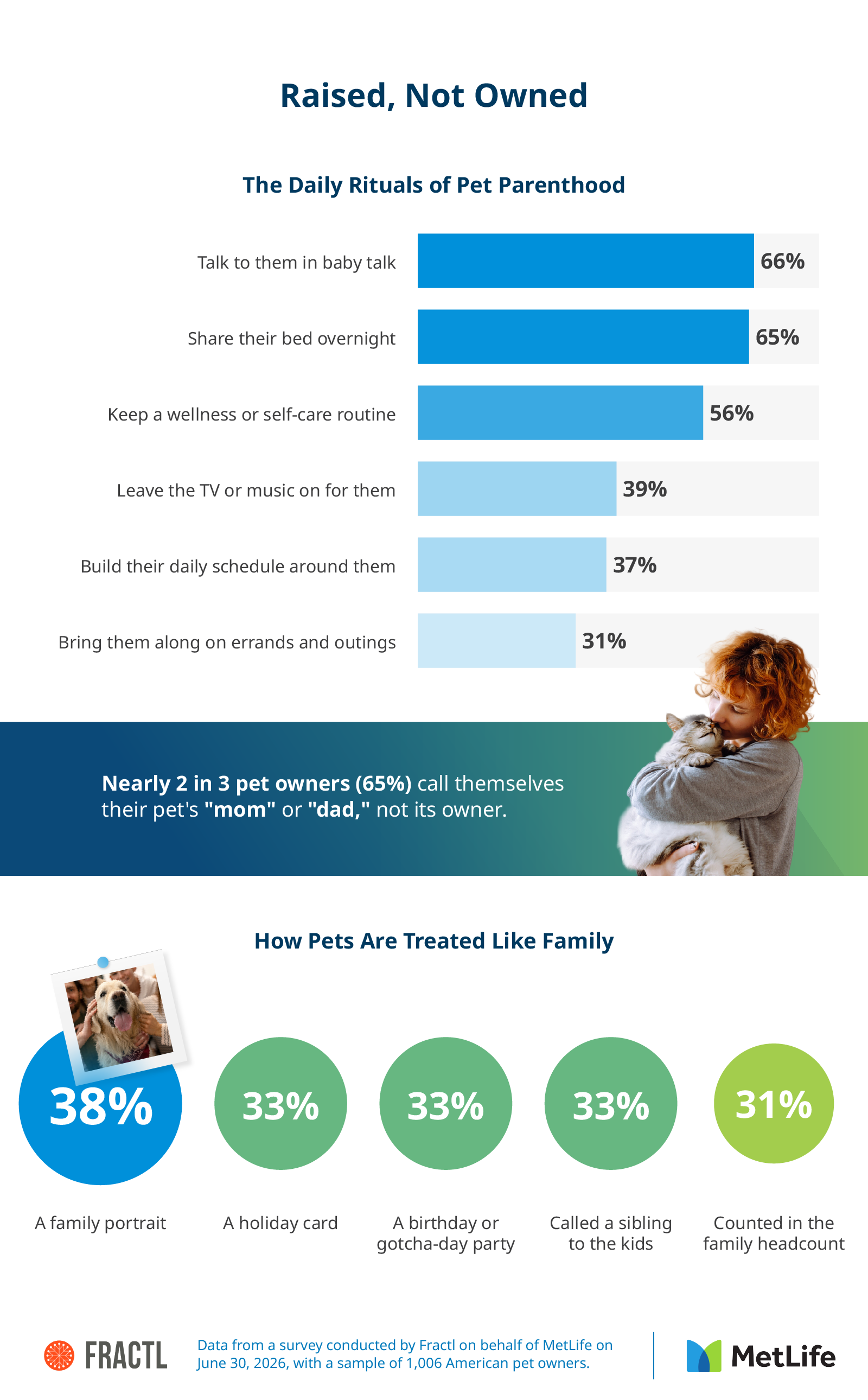
Calling yourself "mom" or "dad" was especially common among women, 74% of whom claimed the title, compared to nearly half of men (49%). Baby talk followed the same pattern and skewed young, used by over three quarters of Gen Z owners (76%) and nearly three in four women (73%), versus 54% of men.
Where pets sleep says a lot too. Three-quarters of cat-only owners (75%) shared their bed with their pet, well ahead of dog-only owners (57%). The celebrations are common as well. One in three owners (33%) have thrown their pet a birthday or "gotcha-day" party, a habit that fell along a clean generational line, from nearly two-fifths of Gen Z (39%) and over a third of millennials (36%), down to a quarter of Gen X (25%) and nearly one in five baby boomers (19%).
Small dogs got the biggest parties.¹ Over two in five small-breed owners (45%) have celebrated their pet, compared to over a third of large-breed owners (35%), and Chihuahua owners led everyone at 53%, followed by Shih Tzu (47%), Pomeranian (45%), Labrador Retriever (40%), and Australian Shepherd owners (40%). For most people, the bond didn't need a milestone to feel official, with 56% saying their pet felt like family from the very beginning.
Put a pet and a child under the same roof, and the pet often comes out ahead.
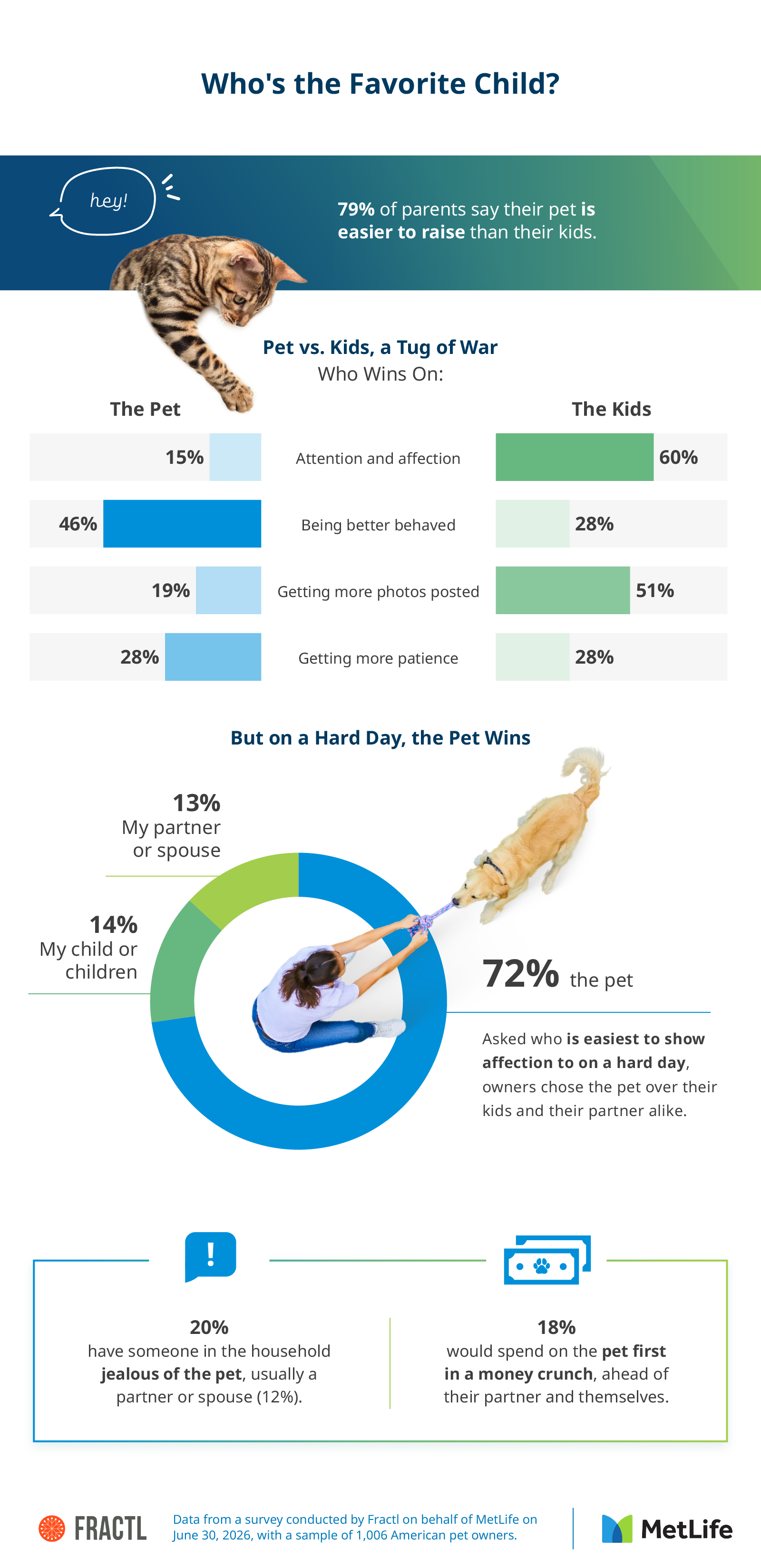
Parents were remarkably united. Nearly four in five (79%) said their pet is easier to raise than their kids, and the agreement held between 76% and 82% across every generation, one of the most consistent results in the study. The pet also won on affection. Over 7 in 10 owners (72%) said their pet is the easiest to show love to on a hard day, ahead of both their kids and their partner, and that held in every generation, peaking at 80% of Gen X and 78% of baby boomers.
The loyalty extends to the wallet. Nearly one-fifth of owners (18%) said they'd spend on their pet first if money got tight, ahead of their partner and themselves, rising to 21% of Gen Z and 20% of Gen X. When kids entered the picture, priorities evened out: asked who they'd spend on first in a crunch, nearly a third of owners chose an even split (31%), and just as many chose their own kids (31%).
For younger owners especially, a pet is increasingly an alternative to having children rather than a step toward it.
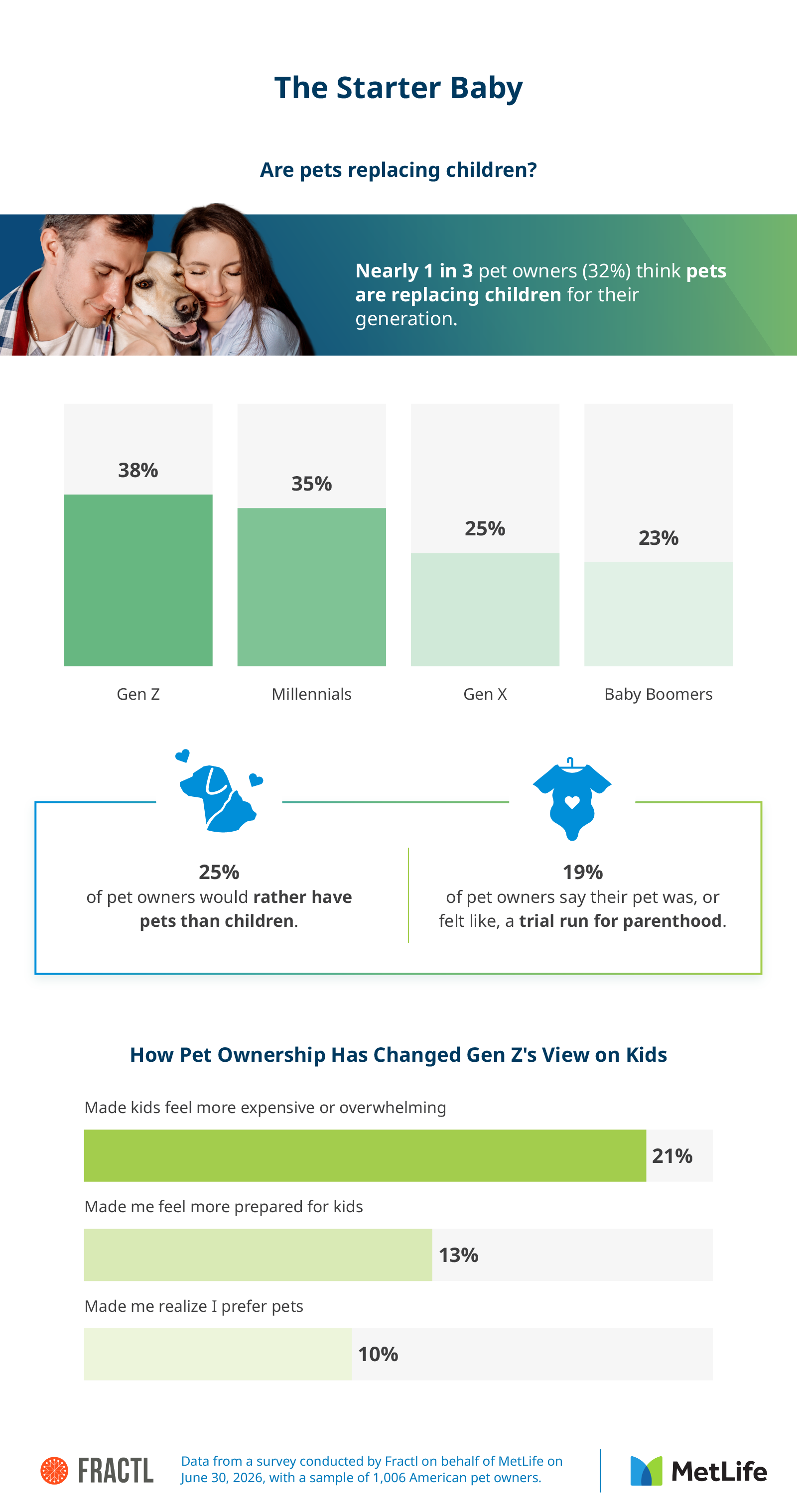
Nearly two-fifths of Gen Z owners (38%) think pets are replacing children for their generation, and the sentiment reached beyond the young. Preferring pets to children was cited by nearly one-third of Gen Z (30%), a quarter of millennials (25%), nearly one-fourth of Gen X (24%), and over one-fifth of baby boomers (22%). Over one in five owners overall (22%) said they don't see pets and children as comparable at all, while just 5% said they want children more than pets.
A pet can tip the scales in either direction. It nudged owners toward parenthood about as often as away from it, with one-tenth (10%) saying it made them more likely to want children and nearly as many (9%) less likely. The generational split was sharper among the youngest owners: nearly one in five Gen Z (17%) said a pet made them less likely to want kids, compared to just 5% of baby boomers. For many, the pet served as a test drive. Over a quarter of Gen Z (27%) and nearly one-fourth of millennials (23%) said their pet was, or felt like, a trial run for parenthood, versus just 6% of baby boomers.
Across ages, genders, and species, pet owners have folded their animals into the roles once reserved for family, and often placed them at the center of it. Pets get the baby talk, the birthday parties, and a spot in the bed, and for many owners they're easier to love and easier to raise than the kids down the hall. For a growing share of younger owners, a dog or cat is becoming a substitute for children altogether. However you rank your own household, the throughline is hard to miss. For millions of Americans, the pet is simply family.
This survey, conducted by Fractl on behalf of MetLife on June 30, 2026, questioned 1,006 American pet owners to explore how deeply they treat their pets like children, how pets stack up against kids in the same household, and how pet ownership is reshaping the decision to have children. The average age of respondents was 41; 62% were female, 36% were male, and 2% were nonbinary. Generationally, 32% were Gen X and baby boomers combined, 49% were millennials, and 18% were Gen Z.
MetLife Pet Insurance provides comprehensive insurance solutions for pets, offering pet owners financial security and peace of mind when it comes to veterinary care. Depending on your level of coverage and the plans you choose, we can cover everything from routine checkups to emergency services. Help your pets get the care they need and worry less about the costs with MetLife Pet Insurance.
This information may be shared for noncommercial purposes only. If you reference or distribute this content, please include proper attribution and a link back to MetLife Pet Insurance.