Maybe you’ve received a denied claim notice, or maybe you’re wondering why claims would be denied in the first place. Either way, knowing what steps to take next can help you feel more confident your pet insurance benefits are working for you. Let’s explore common reasons claims can be denied, what to do after a denial, examples of how claim decisions are made, and ways to help prevent future denials.
The Most Common Reasons Pet Insurance Claims Are Denied
Understanding why a claim could be denied can help you face a current reality or prepare for future claims. Here are several reasons to consider.
Pre-existing conditions
A very common reason pet insurance claims get denied is because the claimed expenses are determined to be connected to a pre-existing condition. The veterinary records you supply with claims help pet insurance companies keep track of symptoms, diagnoses, and patterns in your pet’s health. Since pet insurance doesn’t cover pre-existing conditions, the documents aid in determining whether something is covered or not.
An itchy dog ear your vet examined before you got pet insurance — but didn’t need treatment for — doesn’t seem like an obvious culprit. However, a new ear issue after coverage started might be considered pre-existing if it’s connected to the itchy ear noted earlier in your dog’s records.
As someone who knows their pet’s history, there could be times when you believe a new claim was incorrectly connected to a prior condition. The good news is that most pet insurance providers offer the chance to appeal a claim decision, providing an opportunity for you to supply necessary documentation to help prove your claim is eligible and not connected to a pre-existing condition.
Waiting periods
Pet insurance waiting periods are a window of time after your pet is enrolled in a policy when coverage hasn’t started yet. Across the industry, you’ll likely find waiting periods around 0 days – 14 days, depending on the condition. Claims can commonly be denied if the symptoms, diagnosis, or treatment your pet had were documented as happening during your policy’s waiting period. Knowing the exact dates when your pet’s coverage starts can help remedy this situation.
MetLife Pet Insurance has a 0-day waiting period on accidents and Preventive Care benefits with a 14-day waiting period on illnesses.
Policy exclusions
Some providers and plans have exclusions specified in their coverage that aren’t reimbursable. Common exclusions include:
- Illnesses when you have an accident-only policy
- Routine or elective procedures with any type of pet insurance policy
- Certain alternative treatments or holistic care
- Breed-specific or bilateral conditions
- Food and remedies not prescribed by vets
To lessen the chances of a surprise claim denial, you can usually call your provider before a vet appointment to ask if something might be covered.
Coverage limits or gaps
An annual reimbursement limit2 puts a cap on the maximum amount a pet insurance provider will pay out to a policyholder each year. If you’ve already reached your policy’s limit, this could be the cause of a denied claim. Some providers or plans may also have separate maximums that may cap the amount paid out. MetLife Pet only has annual limits — there are no per-incident, per-condition, or per-lifetime limits associated with our accident and illness plan.
It’s also worth noting that while the claimed conditions or expenses may be covered by your policy, your claim might be approved but not reimbursed if you haven’t met your deductible2 yet. This may feel like a denied claim, but it’s just the cost-sharing process at work and getting you closer to reimbursement.
Gaps in coverage can also trigger a claim denial — whether it’s from a missed payment or switching plans during the time of the vet visit.
Submitting a claim too late
Another reason a pet insurance claim may be denied is if it was submitted outside of the claim submission window outlined by your provider. Typically, you have a certain length of time to submit a claim for reimbursement — for example, MetLife Pet’s is 90 days from the date of the vet invoice. So while the invoice was dated before those 90 days ended, if you submit the claim after the 90 days, it’ll be considered late and ineligible for reimbursement.
Incomplete documentation or records
Similar to the reasoning behind pre-existing conditions, a claim can be denied due to a lack of records or information needed to determine its eligibility. Some of the items that could be missing or incomplete include:
- The itemized invoice
- A pet’s veterinary records
- The SOAP notes from the vet
- Diagnosis, symptom, or treatment details
It could also be that the information was incorrectly filled out. If a provider can’t accurately determine whether a condition or expenses are covered with the information provided, the claim can be denied. You’ll often be notified if more information is needed to process your claim, so it’s important to periodically check its status.
Was Your Pet Insurance Claim Denied or Does Your Provider Need More Information?
If your claim is taking longer than expected, it could be because more information is needed to finish processing it, or a final decision has been made but a notification was missed.
Whether your pet insurance provider needs more information to continue processing your claim, or they’ve accepted/denied the claim, you’ll likely receive a notification. With MetLife Pet, you can also check the status of your claim in the mobile app or desktop portal.
When a claim is processed, you’ll be provided with an Explanation of Benefits (EOB) detailing what was reimbursed or denied, and why. If you haven’t received an EOB yet, it’s likely that your provider is still processing the claim.
What To Do if Your Pet Insurance Denied a Claim
When your claim is denied, there are a few steps you can take to assess the situation and see if a different resolution is possible.
Check for notifications about missing information and resubmit
Sometimes, a claim can be denied or closed because additional information was requested and never provided. Check your emails or your pet insurance account to see if there are any messages about missing information. It could be that you need to submit additional documents.
View the EOB
Take a look at the claim’s EOB to see the reason why something was denied reimbursement. It might state the specific service isn’t included in your policy, you’ve already met your annual reimbursement limit, or the claim was closed due to missing information not provided.
Keep reading for example EOBs and what you might expect to find in one.
If necessary, start an appeal
When a claim — or part of it — is denied, you typically have the opportunity to appeal the decision. For example, you submitted a claim for medication that was denied because it was deemed related to a pre-existing condition. But if your vet can provide additional proof it’s for a brand new condition, you may want to submit a claim appeal. To do this:
- Check your policy details for how appeals are submitted and the timeframe you have to submit them. You’ll often need a written explanation as to why you disagree with the denial, along with supporting evidence.
- Ask your vet for supporting documents that provide proof of your reason for the appeal.
- Follow your provider’s steps to submit the appeal.
- Wait for a decision and monitor your pet insurance account notifications for updates or additional requests.
Contact your pet insurance provider if you have any questions. Once submitted, MetLife Pet will confirm the appeal has been received and typically has 45 days to make a decision.
How Do You Stop Future Claim Denials?
It could be frustrating to believe something is covered by your pet insurance and later find out — after a denied claim — that it isn't. We aim to be as transparent as possible to limit coverage surprises, and there are some steps you can take, too. Before submitting a claim, ask yourself:
- Is this condition eligible under my pet’s plan?
- Has the waiting period ended?
- Could my pet’s medical history affect this specific claim’s eligibility for reimbursement?
- Is this specific expense or service covered — not just the condition itself?
If there are inaccuracies in denied claims, the appeals process can be helpful in particularly complex cases. We’ll work with you and your vet to get all of the information needed to ensure there’s an accurate assessment.
Examples of How Pet Insurance Claims Are Decided
To help you understand how a pet insurance provider may go through a claim determination, let’s take a look at a few hypothetical scenarios with example EOBs and the path to the final claim decision.
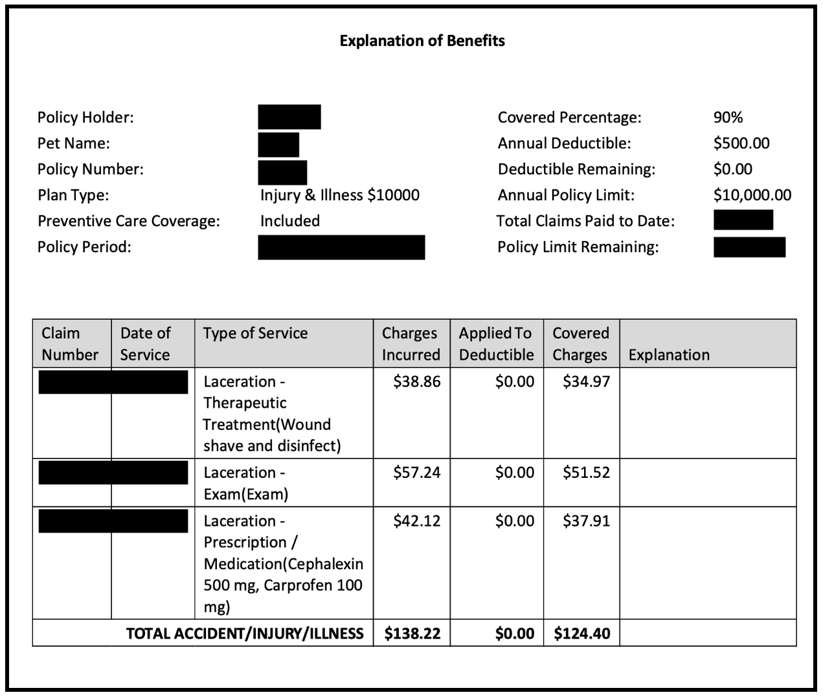
Accident and illness plan example claim scenario
Using the aforementioned common reasons for claim denials as a guide, Scenario A provides us with an example of a claim that would be reimbursable, while Scenario B is an example of when a similar claim would be denied.
- Scenario A: A dog gets injured after the accident waiting period on their plan ends. The dog is brought to the vet for treatment. After paying the bill, the pet owner submits a claim. The injury is covered under their policy, it’s not pre-existing, and the claim was submitted on time, therefore making it eligible for reimbursement.
- Scenario B: A dog gets injured before the accident waiting period on their plan ends. The dog is brought to the vet for treatment. After paying the bill, the pet owner submits a claim. The injury is covered under their policy and the claim was submitted on time, but because the injury was diagnosed before the waiting period ended, it’s considered pre-existing and therefore denied for reimbursement.
The below EOB shows a claim example aligned with Scenario A.2
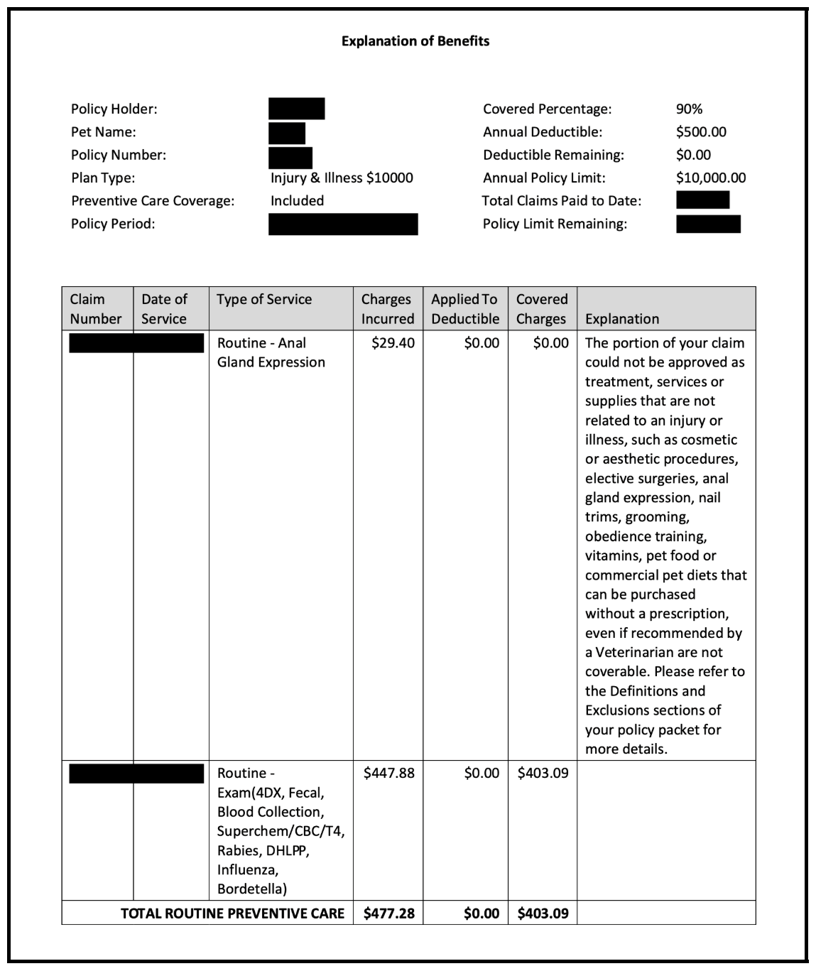
Preventive Care example claim scenario
Our optional Preventive Care plan typically includes a schedule of benefits with specific reimbursement limits for covered expenses and services. Scenario A provides us with an example of a claim that would be reimbursable, while Scenario B is an example of when a similar claim would be denied.
- Scenario A: A dog is brought to the vet for a routine exam after the waiting period on their Preventive Care ends. The annual exam, routine diagnostics, and vaccinations are completed along with a routine anal gland expression. After paying the bill, the pet owner submits a claim. Most of the routine care is covered under their plan, and the claim was submitted on time, therefore making it eligible for reimbursement. The anal gland expression was denied because that specific routine care service isn’t covered by their plan.
- Scenario B: A cat is brought to the vet for their bi-annual routine exam after the waiting period on their Preventive Care ends. The exam, routine diagnostics, and vaccinations are completed. After paying the bill, the pet owner submits a claim. The expenses are covered under their plan, and the claim was submitted on time, but because they’ve already met their yearly reimbursement limit, the claim was denied.
The below EOB shows a claim example aligned with Scenario A.3
FAQs About Pet Insurance Denied Claims
Can part of my pet insurance claim be approved while another part is denied?
Yes, eligible expenses and non-eligible expenses might be submitted in the same claim. During the claims process, your pet insurance provider determines which category they fall into and reimburses you accordingly.
Can a denied claim be approved later?
Yes, if your claim is denied and you submit an appeal, it’s possible the claim could later be approved — as a whole or in part — with supporting documentation.
Does a denied pet insurance claim count toward my deductible?
No, denied claim expenses don’t count toward your pet insurance plan’s deductible. Only eligible expenses are applied to your deductible.
Will a denied claim affect future claims for the same condition?
It’s possible a denied claim could affect the eligibility of future claims for the same condition. Let’s say your pet was diagnosed with allergies before their plan’s waiting period was over. You submit a claim for their allergy medication, and it’s denied because the allergies are considered pre-existing. Any future claims related to your pet’s allergies will also be denied.
In contrast, let’s say your pet had their nails cut as routine maintenance, and that claim was denied because your policy doesn’t cover routine care. Then later, your pet breaks some of their nails during an injury, and part of the treatment is cutting their nails. Even though they’re both nail-cutting services, the second claim was related to an accident, so it was reimbursable.
How long do I have to submit a pet insurance claim appeal?
You have 90 days after the initial claim decision to submit an appeal with MetLife Pet, but it could be different if you have another provider. You’ll need to submit a written explanation — indicating the claim you’re appealing — along with supporting documentation. While the timeline can be extended if additional information is needed, MetLife Pet typically has 45 days to reach an appeal decision.
Feel More Confident About Your Pet Insurance Coverage
Understanding why pet insurance claims are denied can help you navigate coverage decisions, avoid common mistakes, and know what steps to take when a claim doesn't go as expected.
At MetLife Pet, we're committed to making pet insurance easier to understand and use. We offer quick online claims submission and tracking, along with support from claims team members with veterinary experience. Together, these resources can help pet parents feel informed and supported throughout the claims process.
Whether you're reviewing a recent claim or considering pet insurance for the first time, let us help you take the next step. Head to our claims page for additional FAQs and what’s required to submit a claim, or get a free, personalized quote to explore coverage for your pet.
Tricia Latimer-Green is currently a Senior Product Claims Assistant for MetLife Pet Insurance. She worked hands-on as a veterinary technician from 2012 to 2018. After working in-clinic as lead surgical tech, she transitioned to pet insurance adjudication.
Tricia currently has two dogs and five cats — including a kitten with no eyes. She also has had a pig, a squirrel, bunnies, and chickens. The only thing she loves more than advocating for animals is her four children.
We can help you cover vet bills while you focus on your pet’s care
Enroll with MetLife Pet