Would You Call Out Sick for Your Pet?
Oct 12, 2026
Sorry, we couldn't find any results matching
Please:
Sorry, we couldn't find any results matching
Please:
Nearly 1 in 4 working pet parents have called in sick when their pet was the one who was really sick. That comes from a new MetLife Pet Insurance survey of 1,009 U.S. workers. Anyone who has rushed a limping dog to an emergency vet visit on a Tuesday morning knows the awkward call that comes next.1 Do you tell your manager the truth? Or does your pet's emergency quietly become a family thing or a personal appointment?
The survey asked how often a pet's health pulls people away from work, what they tell their boss when it does, and whether a sick pet should count as a valid reason for time off. The answers show how far pet parents go for a sick pet, and how ready they are for workplaces that make room for it. The typical worker gives up a couple of workdays a year to a pet's health, and in every generation, most say a sick pet should count the same as a sick relative.
Most working pet parents have rearranged a workday because of a pet's health, and fewer than half told their boss the real reason.
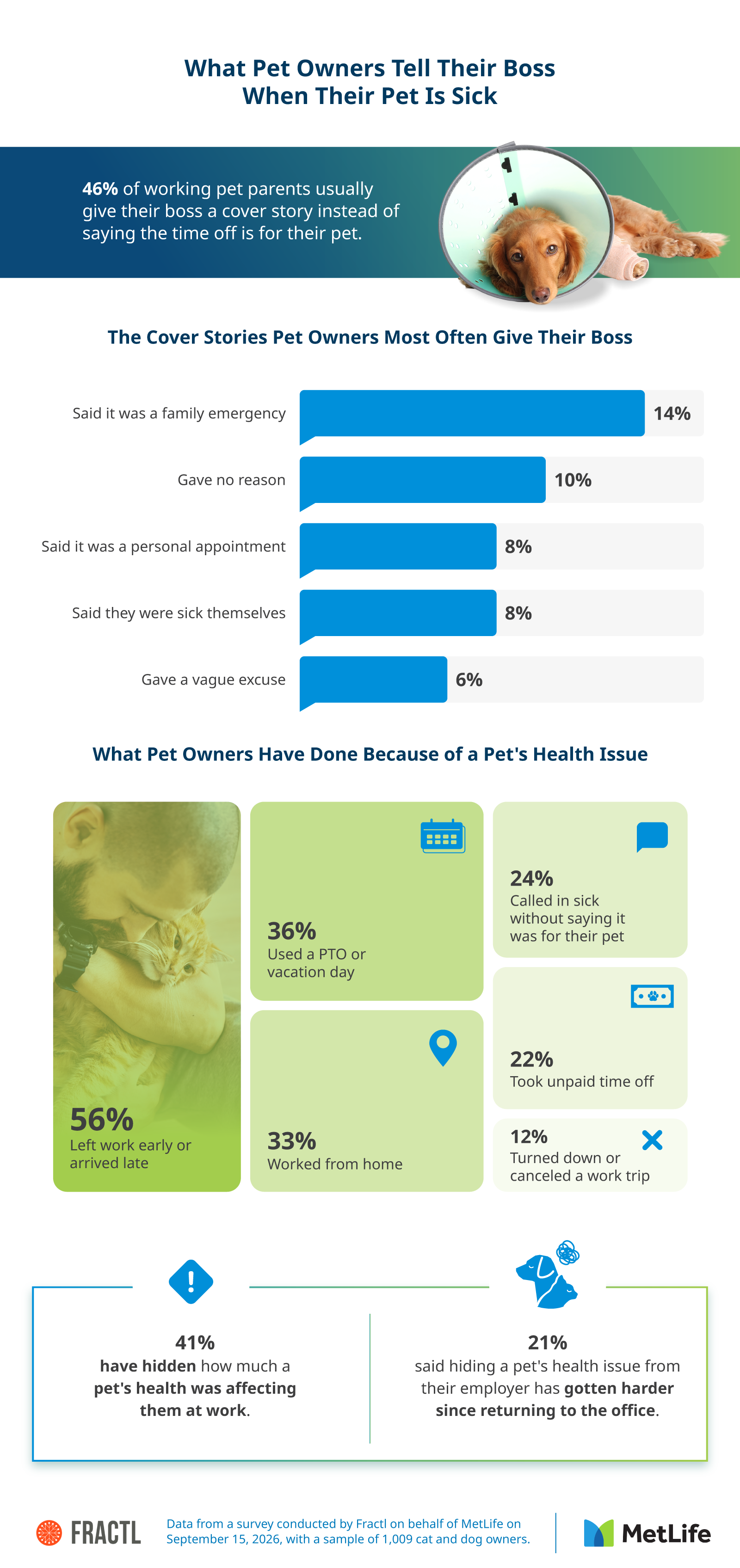
Calling in sick is the quiet workaround. About a quarter of working pet parents (24%) said they have called in sick without telling their employer the day was really for their pet. Zoom out to every kind of cover story, and the number grows: 46% said they usually give their boss something other than the truth when a pet pulls them away from work. A family emergency was the most common stand-in, used by 14% of working pet parents.
The workaround is common because the disruption is widespread: 80% of working pet parents had done at least one of the things we asked about due to a pet's health, from leaving early to taking unpaid time off. Over half (56%) had done two or more. Among those who had taken time off for a pet, 53% usually gave a cover story, while 47% told the truth.
Some workers felt the squeeze more than others. Women were more likely than men to have left work early or come in late for a pet (61% vs. 50%) and to have called in sick without saying it was for their pet (27% vs. 20%).
Returning to the office has made the balancing act harder for workers. Overall, 21% of working pet parents said hiding a pet's health issue has gotten harder since going back in. This group included 24% of Gen Z, 22% of millennials, 16% of Gen X, and 15% of baby boomers.
A sick pet takes time and focus away from working pet parents, and in a real emergency, many would give up far more than a vacation day.
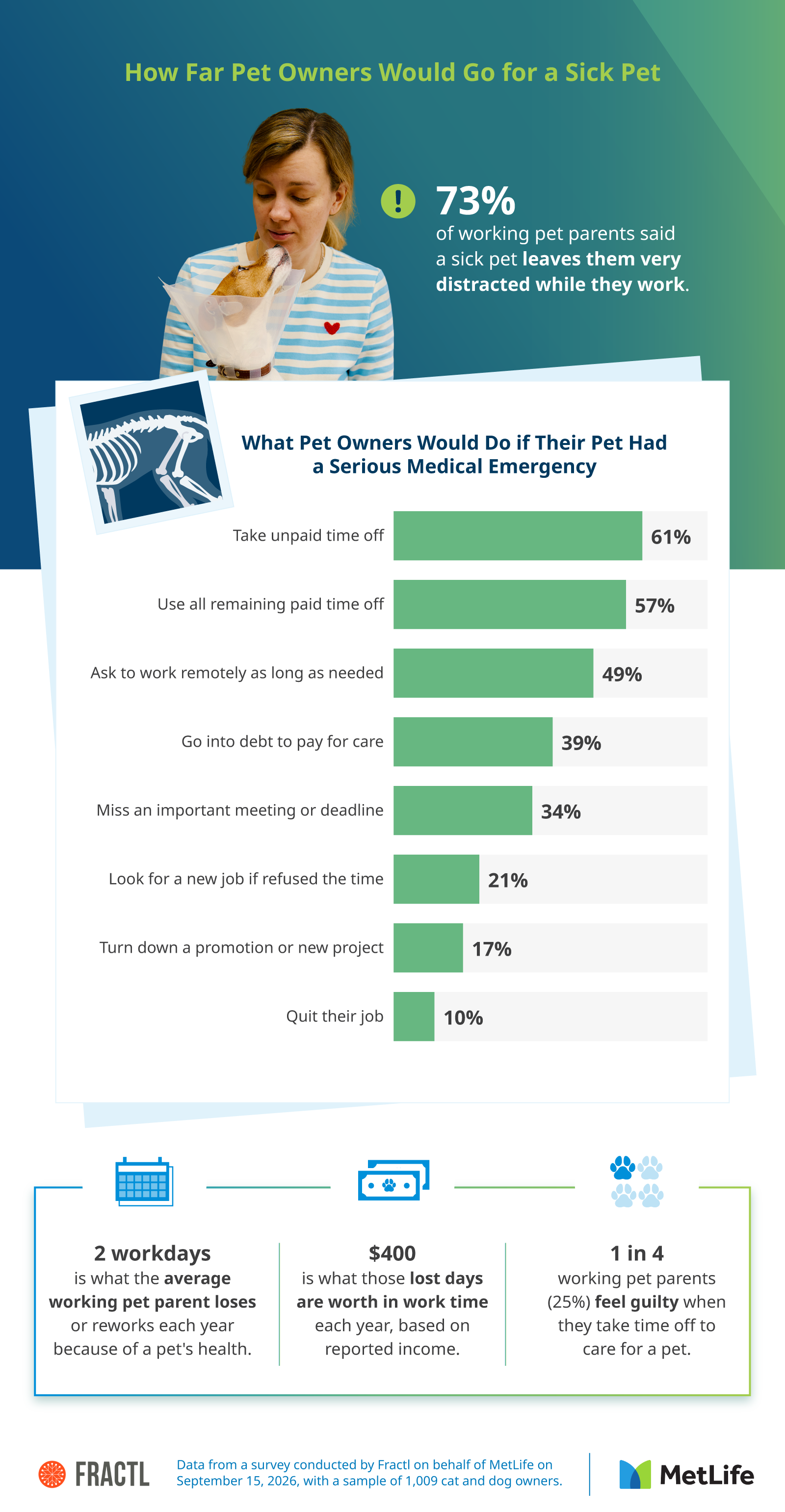
About 3 in 4 working pet parents (73%) said a sick pet leaves them very distracted at work, and 41% had hidden how much their pet's health was weighing on them at the office. That distraction adds up. The average working pet parent lost or reworked about 2 workdays a year due to a pet's health, worth roughly $400 in lost work time based on their income. Nearly 4 in 5 (78%) lost at least one workday in a typical year, and 14% lost five or more.
When a pet's life is on the line, the stakes climb. About 1 in 5 working pet parents (21%) said they would look for a new job if their employer refused them time off for a pet emergency.2 One in 10 said they would quit outright, including 13% of Gen X, 12% of Gen Z, 8% of millennials, and 5% of baby boomers.
Remote work was the pressure valve younger workers reached for first. In a pet emergency, 55% of millennials and 54% of Gen Z would ask to work from home for as long as needed, along with 39% of Gen X and 37% of baby boomers.
Most workers agreed that a sick pet is a fair reason to miss work, and in every generation, more than half want employers to offer leave for it.
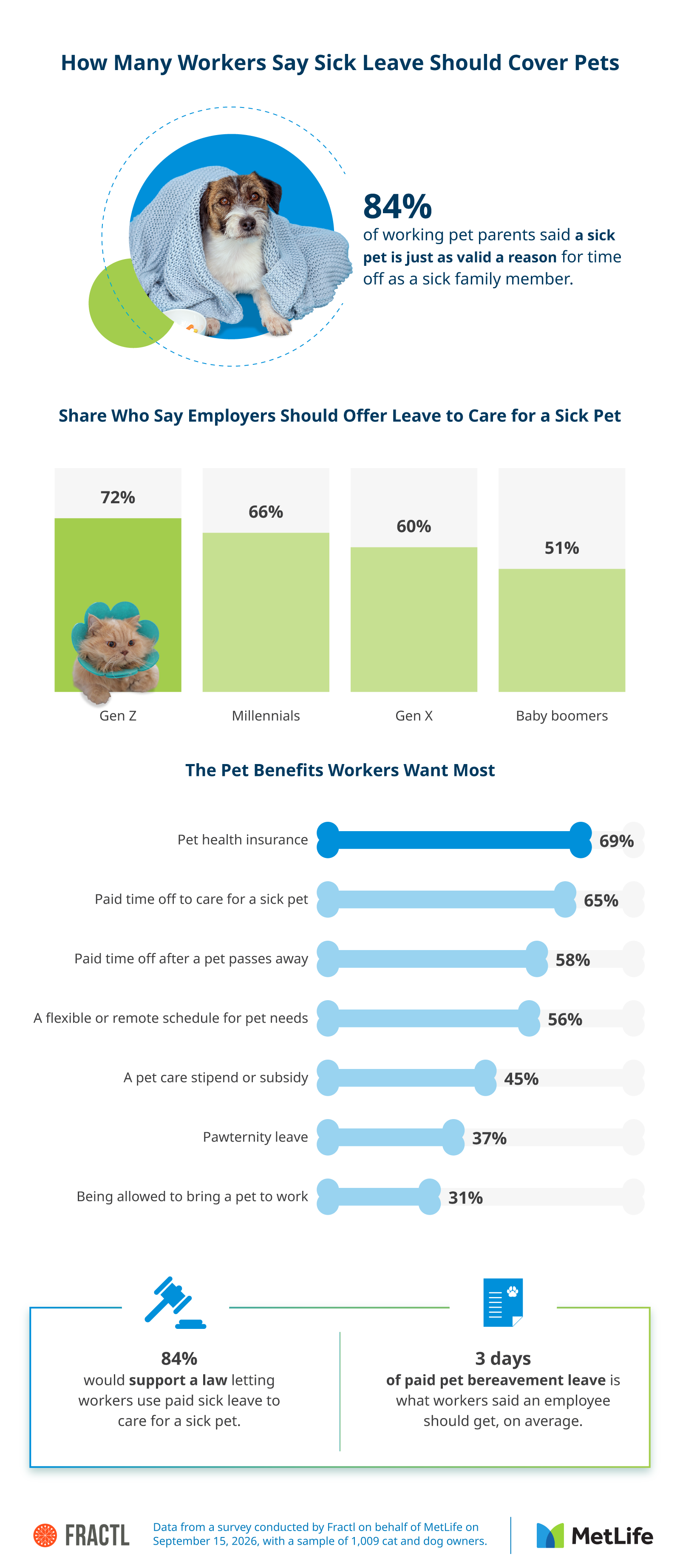
The idea that a pet belongs in the same category as any other family member is nearly universal. More than 4 in 5 working pet parents (84%) said a sick pet is just as valid a reason for time off as a sick relative. This view was common across generations, with 87% of Gen X, 85% of Gen Z, 83% of millennials, and 82% of baby boomers sharing it.
That agreement carries over into policy: 84% would support a law allowing workers to use paid sick leave to care for a sick pet. Support for employers offering pet leave held above half in every generation, from 72% of Gen Z to 66% of millennials, 60% of Gen X, and 51% of baby boomers.
Workers also said pet-friendly policies would influence where they choose to work. About 3 in 4 (74%) said pet benefits would make them more loyal to their employer. Half would leave their job for a similar one with better pet benefits, including 52% of Gen Z, 52% of millennials, 45% of Gen X, and 43% of baby boomers.
Pet health insurance topped the list of benefits that would attract them to or keep them in a job, chosen by about 7 in 10 (69%). Support even extended to loss. About 1 in 3 working pet parents (32%) said employees should get at least a full workweek of paid pet bereavement leave, and 2 in 3 (66%) said at least three days.
Most working pet parents in this survey were not asking for much. They lose about two workdays a year to a pet's health, and many simply wanted to say so without inventing a family emergency. With more than 4 in 5 backing paid sick leave for pets and a majority in every generation behind employer pet leave, workplaces that make room for pets have plenty of goodwill waiting for them. And since pet health insurance is the benefit workers want most, the support pet parents are asking for is already within reach.3
This survey, conducted by Fractl on behalf of MetLife on September 15, 2026, gathered responses from 1,009 U.S. pet parents who hold a job to find out how a pet's health shows up in their working life, from the time they take off and the reasons they give their employer, to whether they think a sick pet should count as legitimate leave. Respondents had an average age of 41, and 60% identified as female, 38% as male, and 2% as nonbinary. Generationally, 21% were Gen Z, 47% were millennials, 26% were Gen X, and 6% were baby boomers.
All respondents owned a dog, a cat, or both, with 41% owning a dog only, 29% a cat only, and 30% both. Averages for workdays lost, their dollar value, and bereavement days exclude statistical outliers, and the dollar value is calculated by multiplying each respondent's reported days by their reported annual income, divided by 260 working days. Percentages may not total 100% due to rounding.
MetLife Pet Insurance provides comprehensive insurance solutions for pets, offering pet owners financial security and peace of mind when it comes to veterinary care. Depending on your level of coverage and the plans you choose, we can cover everything from routine checkups to emergency services. Help your pets get the care they need and worry less about the costs.
Feel free to share the insights from this article for noncommercial purposes only. Please include a link back to MetLife Pet Insurance with proper attribution if you do.