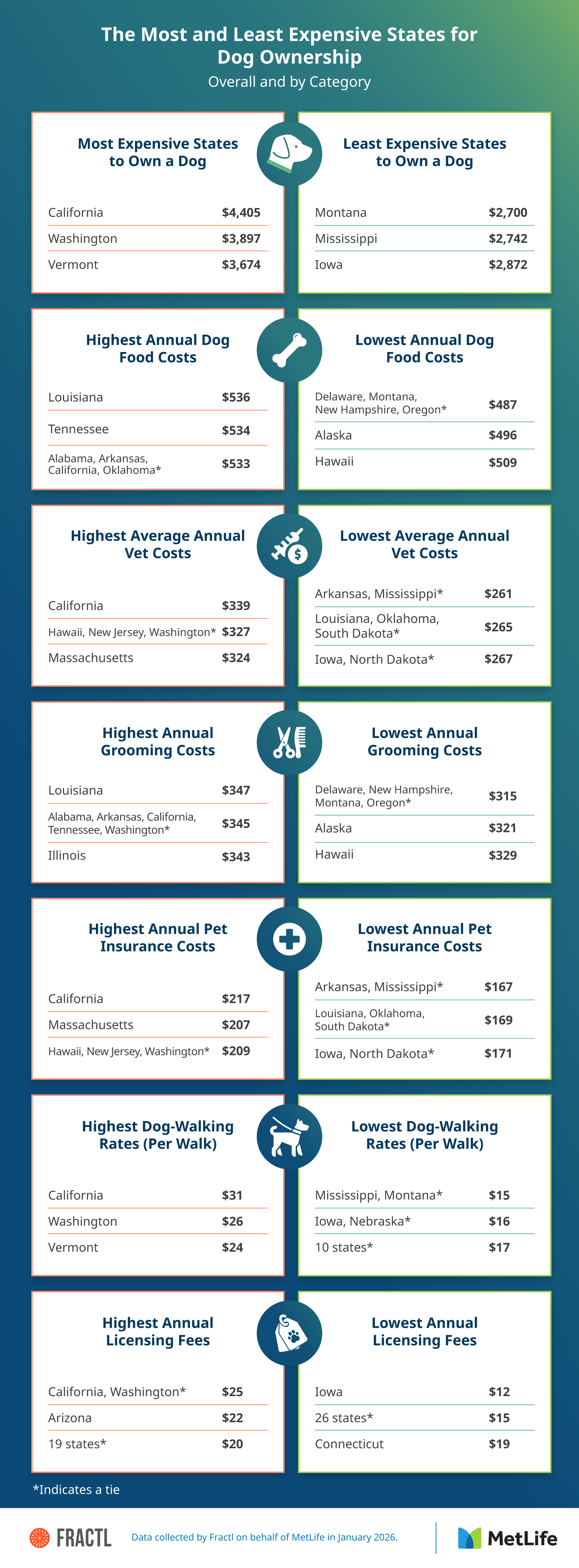
This study estimates the average annual cost of owning a dog across all 50 U.S. states by combining publicly available pricing data for essential dog-related expenses. Costs were standardized using consistent assumptions to allow for fair, state-by-state comparisons and reflect real-world, out-of-pocket spending by a typical U.S. dog owner in 2026.
Cost Categories Included
The final annual cost for each state includes the following six components:
- Dog food
- Veterinary care
- Professional grooming
- Pet insurance
- Dog walking
- Licensing fees
Each category was modeled separately and then summed to produce a total annual cost per state.
Dog Food
Annual dog food costs were estimated using national retail pricing for adult dry dog food across budget, mid-tier, and premium brands. Prices were sourced from Chewy.com and standardized to a price-per-pound basis.4 A weighted average was calculated to reflect typical U.S. purchasing behavior.
Costs were annualized assuming a medium-sized adult dog consumes approximately eight 30-pound bags per year, resulting in a national pre-tax baseline of $487. To reflect real-world consumer spending, each state's combined state and average local sales tax rate (sourced from the Tax Foundation) was applied to the baseline cost.5
Veterinary Care
Veterinary care costs represent estimated routine annual care, including wellness exams and standard vaccinations. A national baseline cost was established using pricing data from Banfield Pet Hospital’s online price estimator, reflecting typical costs for routine veterinary services.6 That national baseline was then adjusted at the state level using the U.S. Bureau of Economic Analysis’ Regional Price Parities (RPPs), a cost-of-living index that measures how expensive goods and services are in each state relative to the U.S. average (U.S. = 100).7
State-level veterinary care costs were calculated by multiplying the national baseline by each state’s RPP value divided by 100. As a result, differences across states reflect overall regional price levels, not differences in the type or frequency of veterinary care provided.
Sales tax was not applied, as veterinary services are typically exempt from sales tax.
Dog Grooming
Professional grooming costs were estimated using a standardized national approach. A baseline price of $60 per grooming session was established based on guidance from the Academy of Pet Careers, a nationally recognized pet-care education organization.8 To avoid overstating costs, we assumed grooming once every eight weeks, or seven sessions per year, resulting in a base annual grooming cost of $420 (pre-tax).
Each state's combined state and local sales tax rate (Tax Foundation) was applied to account for real-world consumer pricing.5 This approach reflects what a typical dog owner would expect to pay annually for routine professional grooming.
Pet Insurance
Pet insurance costs were estimated using MetLife Pet Insurance's advertised starting monthly premium for dogs as a national baseline.9 Costs were annualized and adjusted at the state level using BEA Regional Price Parities to reflect geographic differences in service costs.7 Sales tax was not applied, as insurance premiums are generally exempt from state sales tax. These figures represent modeled averages and do not reflect individualized insurance quotes.
Dog Walking
Dog-walking costs were estimated using publicly listed rates from Rover.com, based on typical pricing in major cities within each state.10
To reflect a realistic “regular dog-walker” scenario without overstating usage, we assumed:
- 2 walks per week
- 52 weeks per year
State-level annual dog-walking costs were calculated using each state's average per-walk rate multiplied by the assumed annual frequency. Where applicable, combined state and local sales tax rates were applied to reflect out-of-pocket costs for services.
Licensing Fees
Annual dog licensing fees were collected at the state level using major city and county government sources, then averaged where necessary to create a representative statewide figure.
All licensing fees reflect the cost for a fixed (spayed/neutered) adult dog, which is the most common licensing scenario in the U.S. Sales tax was not applied, as licensing fees are typically exempt from taxation.
Sales Tax Data
To reflect actual consumer costs, combined state and average local sales tax rates were sourced from the Tax Foundation.5 Sales tax was applied only to categories typically subject to taxation:
- Dog food
- Grooming services
- Dog walking services
Categories generally exempt from sales tax (veterinary care, pet insurance, licensing fees) were not taxed.
Final Ranking
For each state, the costs for all categories were summed to produce a total estimated annual cost of owning a dog. States were then ranked from most expensive to least expensive based on this total. The resulting ranking provides a comprehensive, location-based view of where dog ownership is most and least affordable in the U.S. in 2026.
About MetLife Pet Insurance
MetLife Pet Insurance offers customizable and reliable coverage to help families manage the cost of veterinary care. With plans designed for dogs and cats of all ages and breeds,11 MetLife Pet Insurance supports pet parents in preparing for both routine needs and unexpected illnesses. Explore coverage options for dogs and cats, including wellness add-ons and multi-pet solutions.
Fair Use Statement
This information may be shared for noncommercial purposes only. If you reference or distribute this content, please include proper attribution and a link back to MetLife Pet Insurance.