I'd Foster, But
Sep 09, 2026
Sorry, we couldn't find any results matching
Please:
Sorry, we couldn't find any results matching
Please:
Plenty of people will tell you they care about animals stuck in shelters. Far fewer have ever brought one home, even for a weekend. To understand that gap, Fractl surveyed more than 1,000 Americans on behalf of MetLife Pet Insurance about what they think fostering involves, what holds them back, and whether more flexible options might change their answer. The pattern that emerged points to a barrier that has less to do with how much people care and more to do with what they understand about how fostering actually works.
Americans turn out in force for animal welfare in the abstract. Turning that goodwill into an open door at home is where it tends to stall, and a lot of the reason comes down to what people simply don’t know.
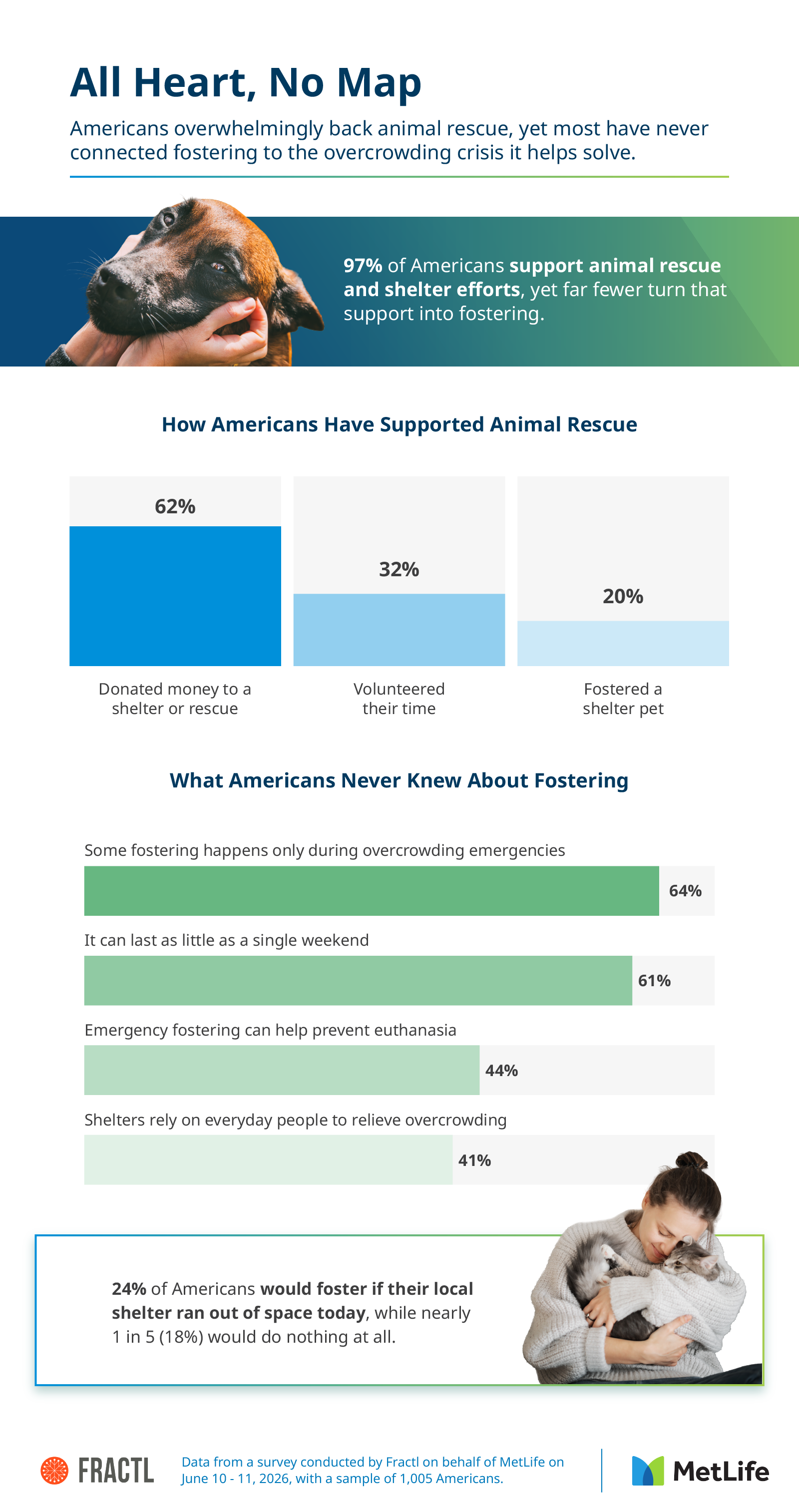
The support is nearly universal. About 97% of Americans backed animal rescue and shelter efforts, yet only 20% have ever fostered a pet, even though far more have donated money or volunteered their time.¹ The willingness to help is clearly there; it just rarely takes the form of a foster placement.
Part of the reason is a basic information gap. Nearly three in five Americans (57%) didn’t realize first-time fosters can take part at all, and just 32% understood that fostering is open to essentially anyone a shelter will support. Many also didn’t know how flexible it can be, from emergency-only placements during overcrowding to stays as short as a single weekend.
Money worries compound the confusion. Nearly half of Americans (49%) assumed they would have to cover food, supplies, and vet care themselves, when shelter and rescue programs usually pick up those costs.
There is also disagreement about whose job it is to step up. When a shelter hits crisis capacity, 62% of baby boomers said residents like them carry the most responsibility to act, a sense of duty shared by only 36% of Gen Z.
Once people understand fostering is open to them, a second set of worries takes over. They tend to be less about logistics than about how the whole thing would feel, and they don’t land the same way for everyone.
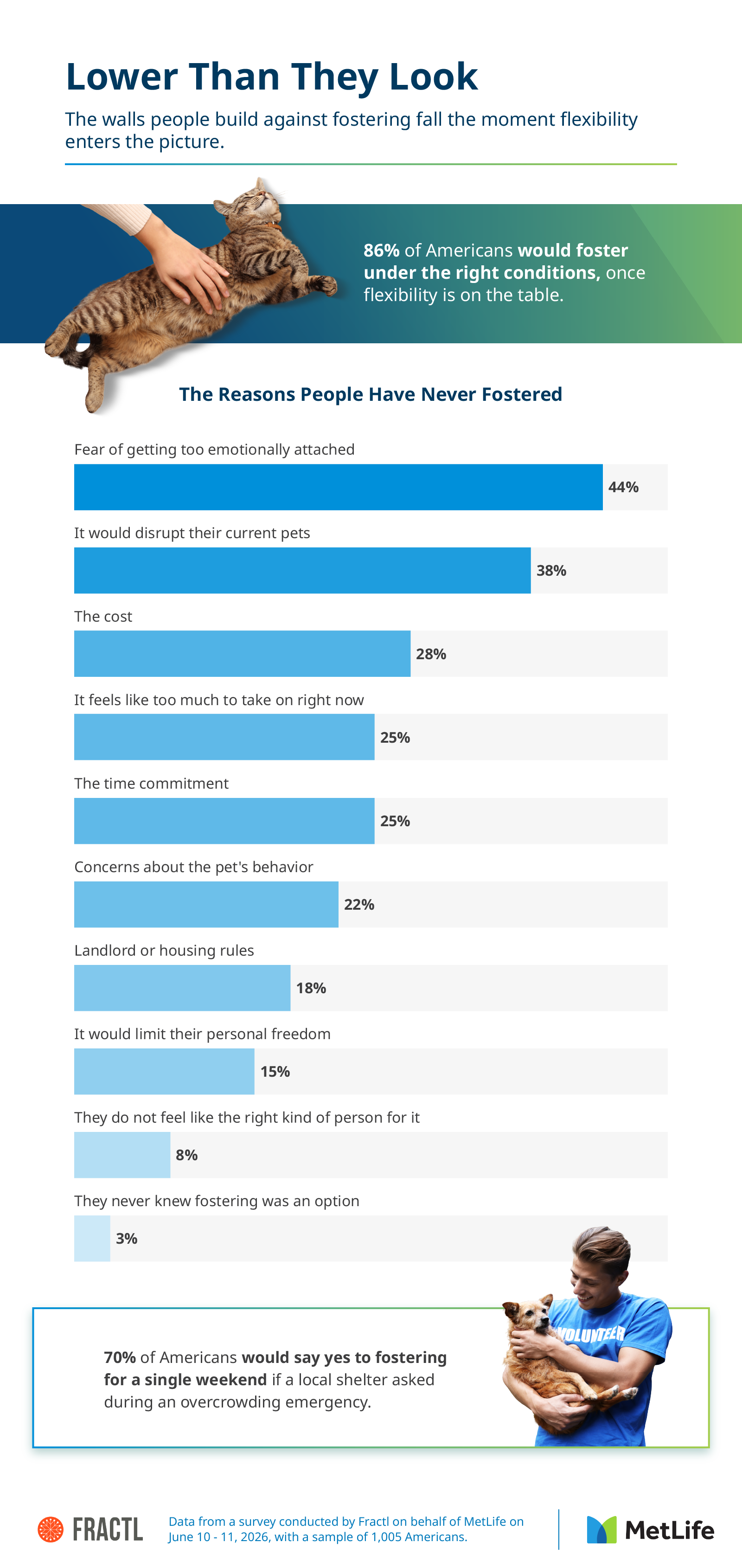
The emotional side weighs on people most. Nearly three in five Americans (59%) said the hardest part of fostering would be getting attached and then having to say goodbye. That fear also tops the list of reasons people have never fostered, and women named it far more often than men, at 53% versus 32%.
Practical concerns stack up behind the emotional one. After attachment, the reasons people gave most for never fostering were worry about disrupting their current pets, the cost, and a sense that it’s simply too much to take on right now, along with the time commitment involved.² Concerns about a pet’s behavior, housing rules, and losing personal freedom rounded out the list.
Some of those barriers fall harder on certain groups. Among renters, 37% pointed to landlord or housing rules as the obstacle in their way, compared with just 5% of homeowners.
A small share stays firmly opposed. Among baby boomers, 19% said nothing would change their mind, against 11% of Gen Z. For nearly everyone else, the resistance softens fast once fostering flexes to fit real life: about 86% would foster under the right conditions, and 70% would say yes to a single weekend if a local shelter asked during an overcrowding emergency.
The barriers look a lot smaller when fostering stops being all-or-nothing. Give people room to shape the commitment around their lives, and the conversation changes.
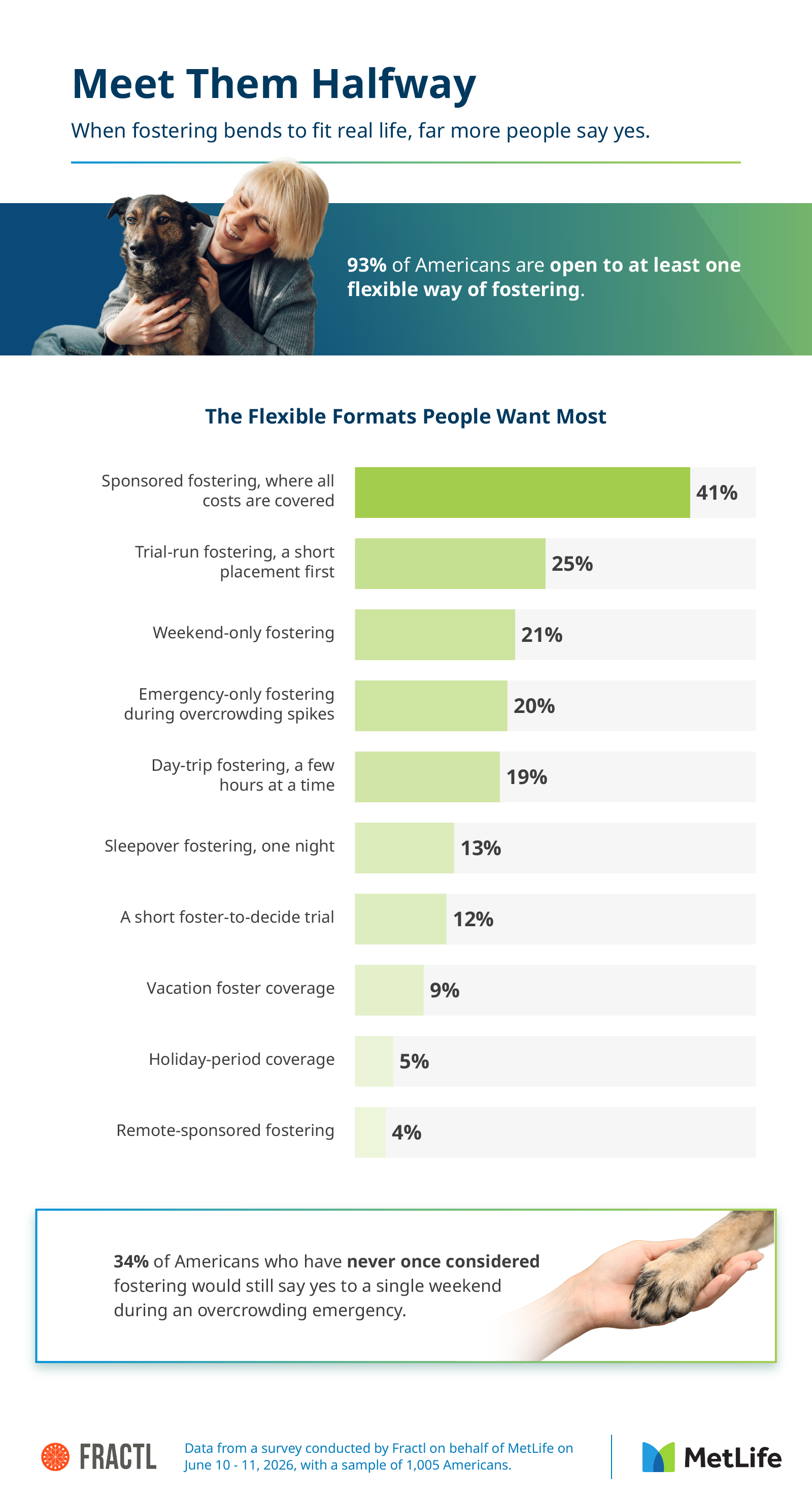
Flexibility is what turns a maybe into a yes. Ninety-three percent of Americans were open to at least one flexible way of fostering, and a weekend-only option on its own made more than one third (36%) willing to sign on, before cost was even mentioned.
Asked which formats appeal most, people put fully sponsored fostering first, followed by short trial-run placements and weekend-only stays. Interest ran well beyond that, to emergency-only help during overcrowding spikes, day-trips of a few hours, single-night sleepovers, and even holiday-period and vacation coverage.
Fully sponsored fostering was the top pick in every generation, chosen by 45% of Gen Z and 35% of baby boomers. Flexibility also reaches people you would assume were out of range: among those who had neither donated nor volunteered, 52% still said yes to a short weekend emergency ask, against 82% of those who had done both. Just over a third (34%) of people who had never once considered fostering would agree to that single weekend.
Knowing what lowers resistance is useful; knowing the exact setup people would opt into is more useful still. Asked to design their own version of a yes, Americans were specific about what it would take.
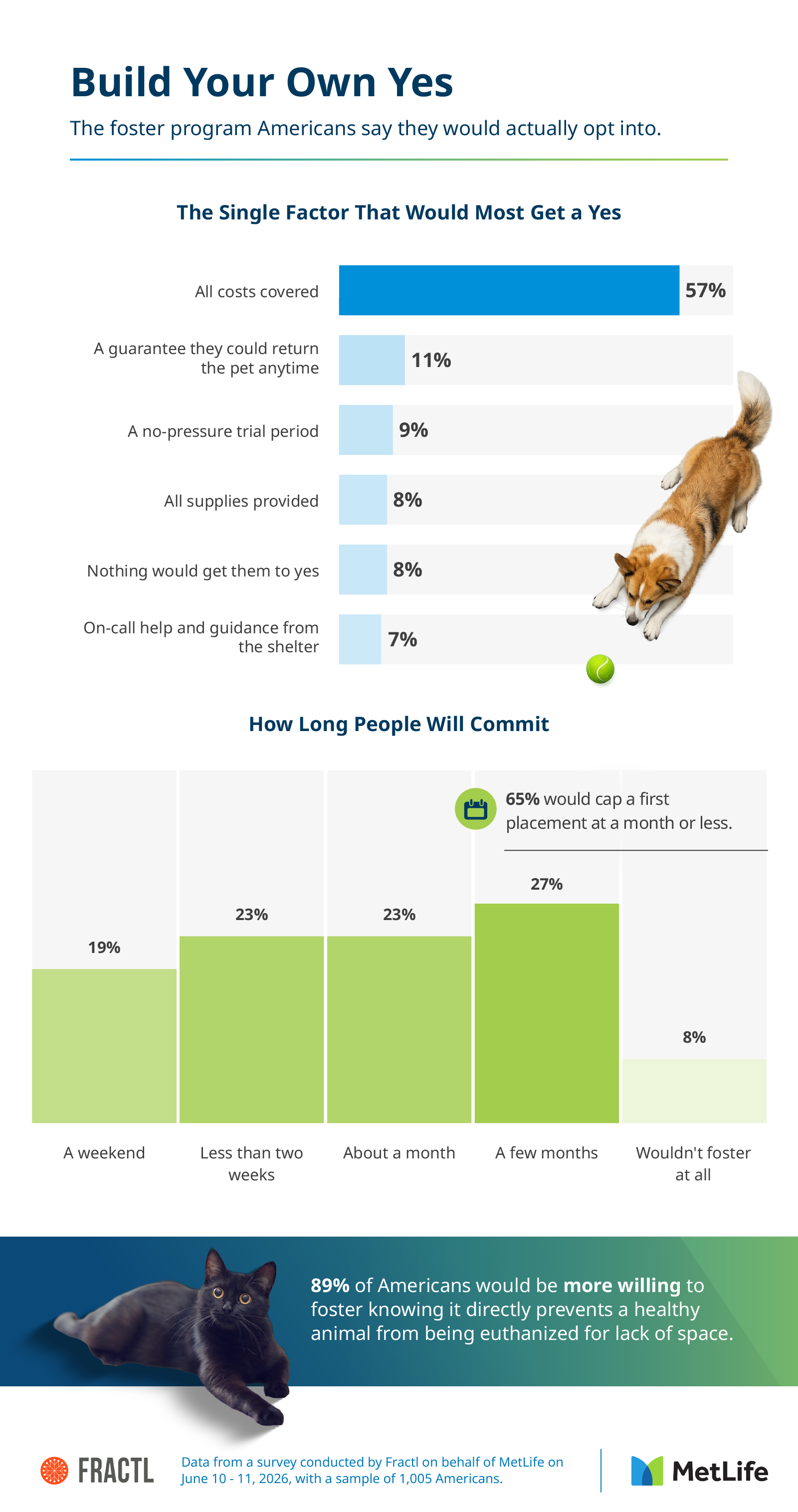
Asked for the single thing that would most get them to foster, people were direct. Covering all the costs mattered more than anything else, named by 57% as the biggest factor, far ahead of guarantees like being able to return the pet anytime, a no-pressure trial period, or supplies and on-call support from the shelter.
One message cut through more than any incentive. Knowing that fostering directly prevents a healthy animal from being euthanized for lack of space made 89% of Americans more willing, and it reached even the hardest holdouts: 56% of those who had said nothing else would change their mind still budged.
People are readier to commit than the stereotype suggests, within limits. Over three in five (65%) would keep a first placement to a month or less, and that ceiling sits lowest with Gen Z, at 75%, against 59% of Gen X. Older Americans, for their part, are the likeliest to have already fostered, at 29% of baby boomers versus 16% of Gen Z.
One of the more unexpected places fostering could get a push is the office. A benefit borrowed from the logic of parental and bereavement leave is drawing real interest.
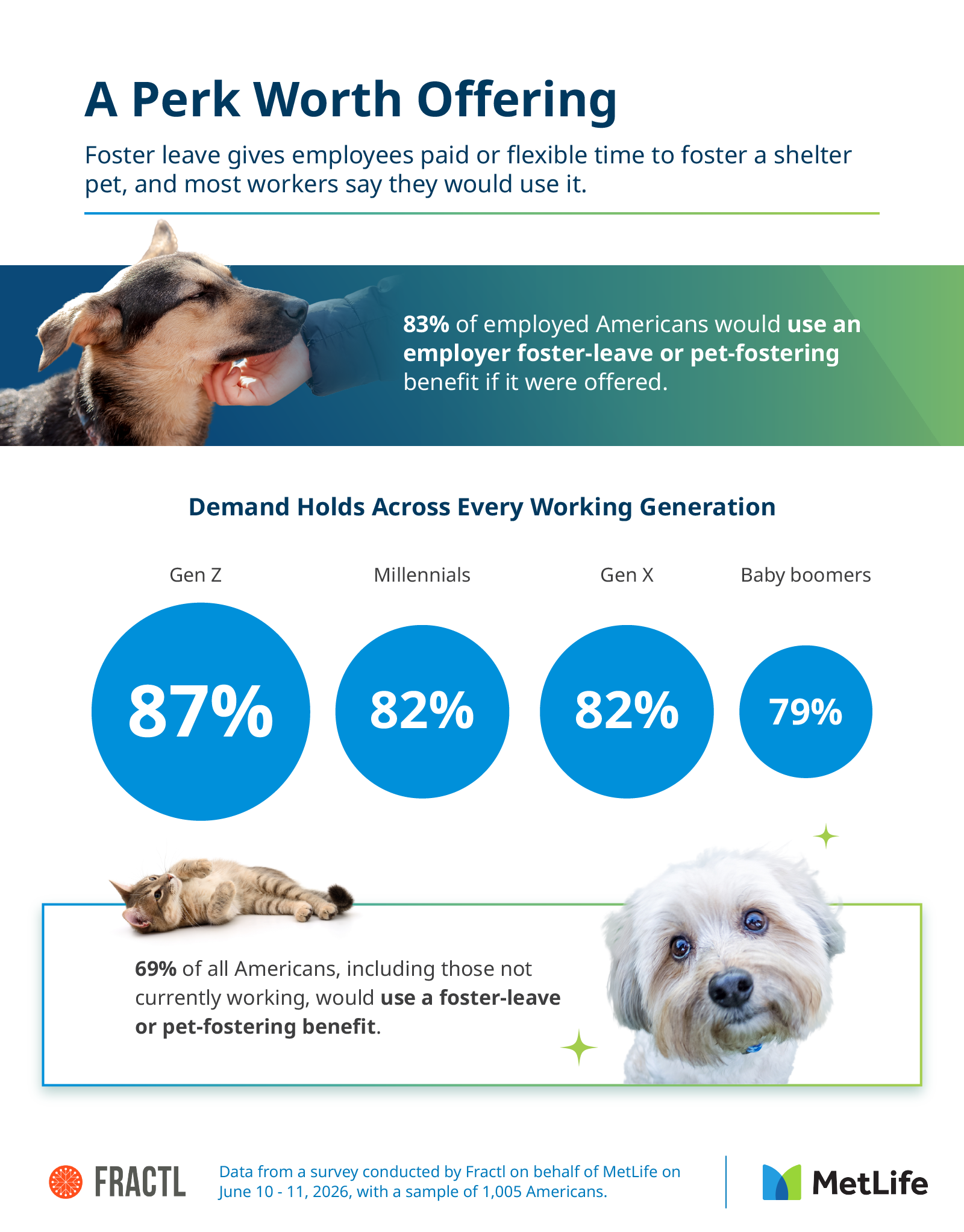
Foster leave gives employees paid or flexible time to take in a shelter pet, usually during the overcrowding emergencies when temporary homes are needed fast. It runs on the same logic as parental or pet-bereavement leave, and it spares people from choosing between their job and an animal that needs a place to stay.³ The interest is hard to ignore: about 83% of employed Americans said they would use such a benefit if their employer offered it.
Demand held up across every working generation. Give employees the option and 83% would take it, with demand holding across every working generation, from 87% of Gen Z to 79% of Baby Boomers. Even counting Americans who are not currently working, 69% said they would use a foster-leave or pet-fostering benefit.
The encouraging part is that the willingness is already there. What’s missing is a clear picture of how fostering works, some reassurance about who pays, and options flexible enough to fit a real schedule. Make it clear that first-timers are welcome, that costs are usually covered, and that even a weekend counts, and many of the people who have been quietly rooting for shelter animals may finally decide to foster or adopt. For the animals waiting on a space to open up, that shift can be the difference between a kennel and a couch.